



A Completely Personal & Irreverent Look At Posters

When I began collecting posters almost 25 years ago, the only thing I knew about them was that they appealed to me visually. Posters are instinctive: one needn’t have any art history background or even a particular field of interest in order to appreciate the beauty and soul evident in each and every vintage poster. Because I was interested, I have learned a great deal about how posters developed, who designed and printed them, and how they came to be regarded (and collected) as some of the most interesting ephemera ever produced.


Since opening L’Affichiste almost six years ago, I have worked with collectors and dealers from around the world, have consulted with museums and foundations, and have worked hard to create not just a gallery for the posters which I love, but also a space and a site where one can learn about posters in the same way I have: by discovering that they are unique, remarkable and collectible pieces of history.
Any website which proclaims to sell authentic vintage posters can give you a great deal of information about how posters evolved and the processes and influences which were important to their development. Many of these sites do a fine job of giving you all the information you could ever want to have about great poster artists like Jules Cheret, Henri de Toulouse Lautrec, Alphons Mucha and Leonetto Cappiello, as well as heaps of data on poster history, design, values, etc.

The problem with that is that I’m not sure that anyone really reads all that stuff …
I decided to approach this section of the site in my own quirky and irreverent style. What follows is a concise, and completely personal reduction of 25 years of knowledge, encapsulated and highlighted by some of the posters I love, items available for sale through this site and at the L’Affichiste gallery in Montreal.
How Posters became… Posters!
From the earliest times we can imagine – and from the oldest archeological evidence we have – man has always decorated his living space. In Lascaux, France the walls of caves thousands of centuries old show drawings depicting animals and hunting; ancient caves in the American Southwest, in Australia, and in South America also give clear graphic indications of social and political structures. Egyptian hieroglyphics incorporated images and icons into the creation of language; remnants from Pompeii show graffiti – political and even sexual – in perhaps the first incorporation of written language and image … but it wasn’t until folks figured out how to create paper that they were no longer required to paint, carve or tile their walls: now they could create something portable, whether for religious, political or purely design reasons.

POSTER + PRINTING: Printing presses facilitated further development, but early posters were originally limited to text – imagine the WANTED posters in old cowboy movies – formulated from what were called letter-presses. Gradual development allowed the introduction of images or sketches into these posters. The earliest color broadsides – posters incorporating color and letter-press text - were charmingly primitive, and give us a great understanding of how quickly advertisers and artists realized the growing importance and power of posters. The possibilities were endless: circus posters , theater posters, posters for travelling road shows … it seemed there was no limit to the types of advertisers and marketers who grasped the visual power and potential of posters.


JULES CHERET: Which brings us, in the most roundabout, and perhaps not sufficiently respectful way, to a man named Jules Cheret. Any poster dealer, collector, website or reference book will tell you that Jules Cheret is the ‘father of the poster’: the man who single-handedly managed to transform the French lithographic process from a fairly mundane and moribund thing into a lively, colorful and exuberant examination of theater and fashion.


Without belaboring the technical details, Cheret looked at what had been previously accomplished lithographically, and moved it forward stratospherically - he may have been the first artist to realize that while the size of presses might be limited, there was no real reason not to glue two posters together to create one which was twice as large as anything which had previously been thought possible. With two-sheet posters, and later four-and-more sheet posters appearing on the kiosks and sidings of Paris (and most other metropolitan cities in Europe) poster artists were suddenly able to have paper canvases that might just be large enough for their imaginations.


While Cheret is credited with technically advancing the poster, Henri de Toulouse Lautrec, a contemporary of Cheret’s, was responsible for giving the French poster of the late 1890’s and early 1900’s life and élan. Lautrec’s posters – some of them so scandalous they were censored – showed a completely different Paris than those of Cheret: while Cheret was very decorous, Lautrec was risqué and had a great love of the seedier side of life: prostitutes, cabaret artists and sexual deviants of every size and type were subjects of choice. Lautrec was perhaps the first to realize that sex sells – and with clients like the Moulin Rouge cabaret, which featured dancers who wore nothing under their petticoats – Lautrec had lots of material to work with.


The established Parisian printing house of Chaix, boldly noticing the French ‘postermania’, began issuing a collection called the Maitres de L’Affiche: a subscription series of collection posters which Chaix printed in miniature, thereby giving the poster-loving public the opportunity to own their own small scale version of what Chaix called the most important posters of the world at the time. The Maitres collection is fairly egalitarian – included in the collection are artists from England, Belgium, America, and other countries – but as the advances in the lithographic process really was credited to Cheret, (and as Chaix was, after all, a French firm), it was the French poster artists who were best represented in the Maitres de L’Affiche collection.
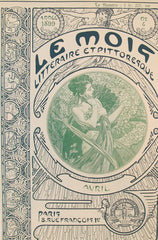

ART NOUVEAU/BELLE EPOQUE: At roughly the same time as Lautrec was getting to know the underbelly of Paris – and enjoying it – a wonderful and prodigiously talented Czech artist named Alphons Mucha was falling in love with the beauty of the female form in an entirely different way. Mucha’s Belle Epoque woman was much more coy in her seductiveness, much less brash and brassy. Mucha was prolific and had no trouble producing commercial art – for companies like LU biscuits, while concurrently creating decorative panels.

ART DECO: Art Nouveau was all sinuous lines and florals – pretty women doing pretty things in environments that could make your mouth water. What followed – the Art Deco period (roughly 1920-1940) was almost at the other end of the spectrum graphically: strong colors, bold lines, messages which were – for the most part – impactful and important. Deco would not have been possible without Nouveau, and the gallery glamorizes both periods with equal emphasis.
So many of the classic poster artists who are considered to be THE most collectible worked during the 1920’s and 30’s: Cassandre, Carlu, Cappiello… Each had a style which Each had a style which was unique and almost instantly recognizable: Cassandre was a graphic master, Carlu (who overcame the loss of an eye at an early age) created innumerable images which are


still considered classics, and Cappiello… well, Cappiello is the ne plus ultra of poster design and a marketer par excellence. His Maurin Quina poster, his Nil, his Cachou Lajaunie, Veuve Amiot - any poster dealer worth their salt will have these in their galleries and their homes.
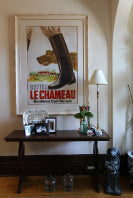

Art Deco pieces are exceptional value in terms of their design impact and their investment value: the first large piece I bought when I started collecting was Cappiello’s Nitrolian – it is now worth roughly 4 times what I paid for it about 20 years ago.
MID CENTURY MODERN + CONTEMPORARY POSTERS: When I opened the gallery I was stuck very much in the Art Nouveau-Art Deco periods. To me, if a poster wasn’t made within that short window of time – 1890-1940 – it wasn’t vintage, wasn’t important, and certainly wasn’t worth selling. Boy, was I wrong.


Transportation, which was always a big end-user of posters for publicity purposes, created great posters in the period of 1950-1970s. Sabena, the national Belgian airline, commissioned some lovely posters – we have a pair which we love, and Air France, always a power-house when it came to using posters as an advertising medium, in 1968 hired Georges Mattieu to design a series of 14 posters – each featuring a destination to which Air France flew – that are as much of a departure from Art Nouveau and Art Deco as possible. They are unusual, they are stupendous, and they are so very different from anything I thought I would buy or sell – I’m glad to say they opened my eyes to poster design of a completely different nature.


Whether posters are from China during the cultural revolution, Quebec during the so-called Quiet Revolution, or from Algeria during its own revolutionary period every poster from every age reflects the social, political, economic and artistic realities of its time.
How are Poster prices determined?
PRICING: The most common question (after ‘how can you tell a poster is authentic, and vintage?’) would be “How are poster prices determined?” To this, I would have to say that there are four basic factors which determine price:
How rare the poster is – Does every poster dealer have a copy of this poster or is it an uncommon print? If it’s rare, it is more likely to be more expensive than a typical, even classic vintage poster.
Who designed the poster – Clearly a Cappiello will (generally) command Cappiello-like prices. Most posters by anonymous artists (there are exceptions, of course) are less likely to be as expensive as those by artists designated as ‘masters’.
Condition – All of L’Affichiste’s posters are in excellent or very good (A, A-, B+, B) condition. I cant sell what I wouldn’t buy and I am meticulous in my condition reports – it is has a flaw I will let you know. If it has toomany flaws or repairs I wont sell it. Period.
Market – As Montreal is a smaller market than say, New York or Chicago, I simply can not ask the same prices as other dealers in those markets. Some of the posters I sell are being sold for twice as much elsewhere – the same poster, produced at the same time, by the same artist and printed by the same printer. These are just the facts of the marketplace – it always makes sense to shop around… but I am fairly confident in my prices.
There is so much more to be said about posters – I am happy to answer any questions, send more photos – but when I started writing this I wanted to make it brief…. it’s not brief, but I think it covers the basic and gives you a clear idea of who I am, what I think, and some of the posters we sell at L’Affichiste. Enjoy!
